Smiljan, July 10, 1856
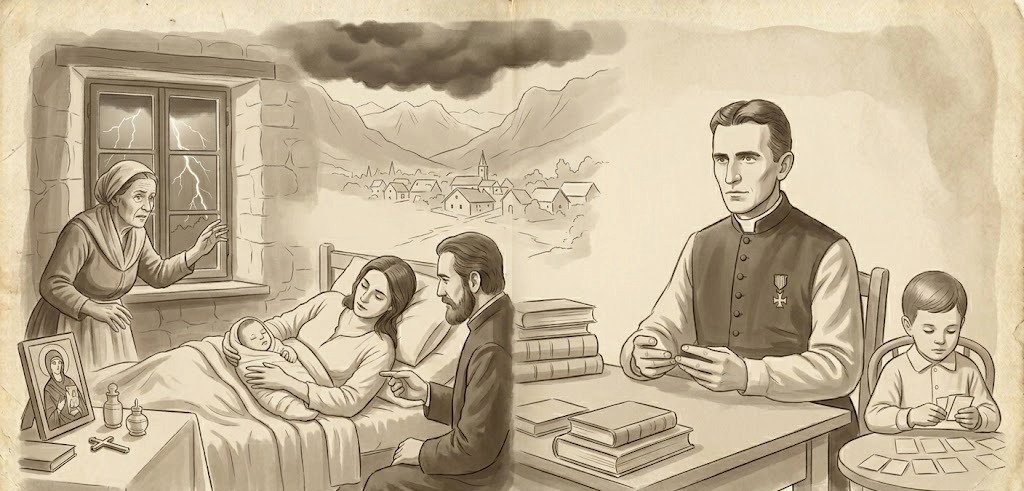
The midwife was afraid of storms. That much the family remembered clearly. She was there in the small stone house in Smiljan, in the Lika region of what is now Croatia, on the night of July 9th rolling into the morning of July 10th, 1856, and the lightning outside was fierce enough to rattle the windows and put genuine fear into a woman who had likely attended dozens of births in that village. When the baby finally arrived, right at the stroke of midnight, she looked at the storm and announced her verdict. “He’ll be a child of the storm,” she said. Đuka Tesla, exhausted and barely recovered from labor, lifted her head and corrected her. “No,” she said. “Of light.”
The baby was Nikola. He was baptized within 24 hours, which in the Serbian Orthodox tradition usually meant the child’s health was in doubt and the family wanted the sacrament secured before anything could go wrong. Village lore, recorded and passed down through the Smiljan community, held that the infant’s heart was beating on the right side of his chest. Whether this was true or a story that accumulated around an unusual child, nobody can say with certainty. What is documented is that the priest who performed the baptism, Toma Oklobdzija, came from nearby Gospic specifically to the Tesla house rather than waiting for the child to be brought to the church. The godfather was Jovan Drenovac, a captain in the Krajina army. Nikola’s birth certificate, now held in the Nikola Tesla Museum in Belgrade, records his birth as June 28th according to the Julian calendar, which translates to July 10th in the modern Gregorian calendar. Smiljan Serbs who knew the family said afterward, with the kind of admiring certainty that small communities grant to certain children: “Our priest has children above all children.”
The village itself was remote in a way that’s difficult to picture now. Lika was a mountainous region under Austro-Hungarian rule, inhabited predominantly by Serbian families who had maintained their Orthodox faith, their language, and their customs across centuries of occupation. The nearest significant town required a day’s journey. Electricity was still a theoretical curiosity debated in European universities. The Tesla family was, within this context, educated and distinguished. Milutin and Đuka had five children across fifteen years, four of whom survived to adulthood, and within the extended Mandic-Tesla family network spanning back to 1750, there were no fewer than 36 Serbian Orthodox priests. It was a dynasty of clergy and scholars, and Nikola arrived into it as the fourth child and the second son.
The priest who could reconstruct lost books from memory
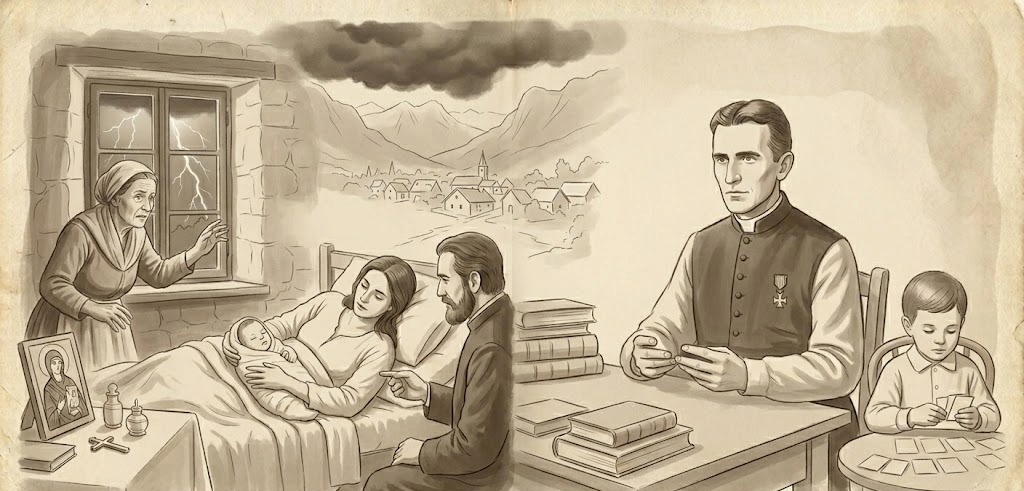
Milutin Tesla was the kind of man who is easy to underestimate from a distance and impossible to underestimate up close. He served the Serbian Orthodox Church as a parish priest in Smiljan and later in Gospic, but the description barely captures him. He was a philosopher, a poet, a naturalist, and an orator. He spoke at least eight languages, possibly more depending on the source. He wrote poetry in his spare time, including a piece called “New Year’s Greeting” that was only recovered by Serbian researcher Milovan Matic after 25 years of archival work. He engaged Goethe and Schiller not as cultural decoration but as serious intellectual interlocutors. He wrote on education, health, natural disasters, and social issues for Serbian publications.
His memory was the family’s most celebrated feature. He could recite long works in multiple languages from beginning to end without error. He joked, and people who knew him understood it wasn’t entirely a joke, that if the great classical texts were ever lost, he could reconstruct them from memory. This claim, documented in Tesla’s own autobiography, reveals something important: Milutin didn’t just possess knowledge. He had internalized it to a degree that made the boundary between knowing and being almost invisible. His most prized physical possession was a 236-page prayer book, the Sluzbenik, printed in Venice in 1517 by Bozidar Vukovic. He kept it his entire life. After Milutin’s death, Đuka kept it. After her death, Nikola took it to New York and had it restored. After Tesla’s death it passed to his nephew Sava Kosanovic, who in 1950, serving as Yugoslavia’s Ambassador to the United States, presented it to President Harry Truman. It sits today in the Harry Truman Library in Independence, Missouri. A prayer book printed in Venice in 1517, that traveled from a mountain village in Croatia to a priest’s study to New York to the White House to Missouri, carried through five hands across four centuries.
In 1873, Emperor Franz Joseph awarded Milutin the Golden Cross of Merit, First Class, a distinction significant enough to be reported in the Viennese press. The Serbian priest from Lika had been noticed at the highest levels of the empire. He was, by any measure, a remarkable man.
He was also a stern father with a fixed vision for his eldest son. Young Nikola was subjected from early childhood to daily mental exercises designed by Milutin to build memory, reason, and critical thinking. Tesla described these in his autobiography without resentment, noting they were “undoubtedly very beneficial,” though the tone of a man describing calisthenics he didn’t choose. Milutin wanted Nikola in the priesthood. The library walls, the languages, the discipline, the daily exercises: all of it pointed toward a particular future that Nikola had no intention of inhabiting.
The woman nobody photographed
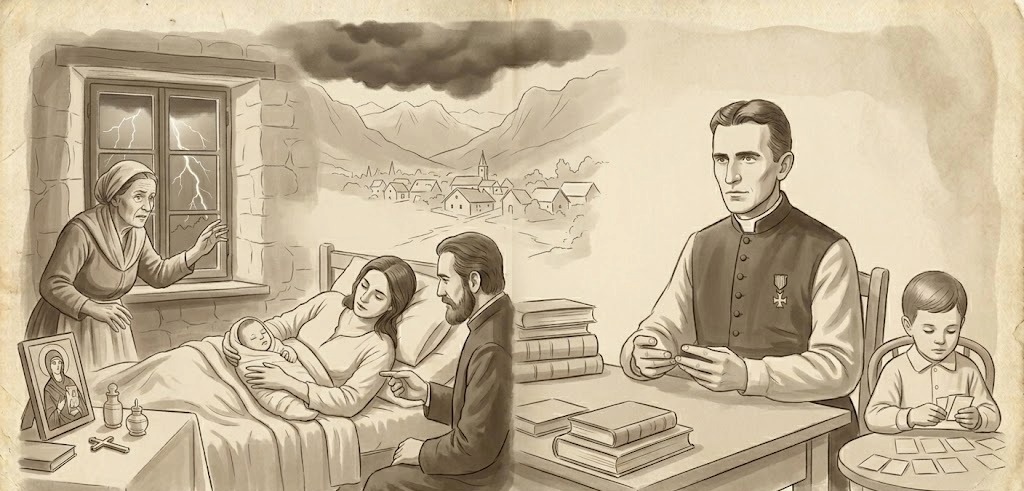
Đuka Tesla was never photographed. This is a fact that stops you when you encounter it, because Nikola Tesla would eventually become one of the most photographed scientists of his era, and his mother, by his own testimony the most important person in his intellectual formation, left no visual record of her existence.
She was born in 1822 in Tomingaj, the daughter of a Serbian Orthodox priest, the oldest of eight siblings, in a family that combined religious tradition with practical intelligence in equal measure. When her mother went blind, Đuka was sixteen years old. She became the effective head of the household, raising seven younger brothers and sisters, managing the farm and the home, and doing it all without ever learning to read. She married Milutin Tesla in 1847 and bore five children in nine years.
What she built during that time is specific and worth naming precisely. She invented a loom, doing so without having ever seen one, working entirely from spatial reasoning and an intuition about mechanical systems that her son would later describe as a first-class engineering mind. She invented a mechanical egg beater. She built and modified domestic tools and appliances throughout her life, each one constructed from scratch, each one solving a practical problem that existing tools hadn’t addressed. She also memorized thousands of lines of Serbian epic poetry and could recite them on demand without error, which in a household already distinguished by Milutin’s extraordinary memory meant Nikola grew up surrounded by two people whose internal lives were richer and more textured than most educated Europeans of the period.
Tesla wrote about her with an intensity he reserved for almost no one else. “My mother was an inventor of the first order,” he said, “and would, I believe, have achieved great things had she not been so remote from modern life and its manifold opportunities. She invented and constructed all kinds of tools and devices and wove the finest designs from thread which was spun by her.” He credited her genetics and her influence for his eidetic memory and his creative abilities. When she died in 1892, while Tesla was traveling, he took a train home, sat with her body through the night, and returned to work the next morning because he believed she would have wanted that. Her last recorded words to him, spoken near death, were: “You’ve arrived, Nidžo, my pride.” He never forgot them.
There is one more story about Đuka that reveals something essential. When Nikola was in his early twenties and had developed a serious gambling habit, losing everything at cards during a particularly bad summer, Đuka came to him without reproach and handed him a roll of bills. “Go and enjoy yourself,” she said. “The sooner you lose all we possess, the better it will be. I know that you will get over it.” He did. He never gambled again after his mid-twenties. Years later he wrote that this response, her absolute certainty in him at a moment when he had given her no reason for certainty, was one of the things he thought about most when he thought about what shaped him.
The brother he never stopped competing with
Dane Tesla was born in 1848, eight years before Nikola. By every account from the family and from Tesla himself, Dane was the gifted one. Extraordinary intellect. Phenomenal memory. The kind of child that a household of remarkable people recognizes immediately as something different even from themselves. He was twelve years old when Nikola was five. The family had an Arabian horse, a gift from a close friend, an animal Milutin described as possessing almost human intelligence and which was petted and indulged by the household accordingly. Nikola was considered too young to ride it.
What happened next has two versions and Tesla never clearly resolved them. In the version Tesla told in his autobiography, Dane fell from the horse. He described the animal in almost mythological terms, as if by elevating the horse into something extraordinary he could distribute the blame across a force larger than any one child’s action. In the other version, carried by some biographers and archival sources, Nikola spooked the horse deliberately, possibly with a blowgun pea, causing it to throw Dane. A third account suggests Dane fell down cellar stairs and in the delirium of his head injury accused Nikola of pushing him. What is undisputed is that Dane fell, sustained injuries, and died. Nikola witnessed it. He was five years old.
The death marked the Tesla family permanently. Đuka, the night Dane died, woke young Nikola from sleep and whispered “Come and kiss Dane.” Then she put him back to bed and said, with tears running down her face: “God gave me one at midnight, and at midnight He took away the other one.” On September 1, 1863, the family left Smiljan entirely and moved to Gospic. They never went back to live there. Nikola served as a bell ringer in the new parish church in Gospic, a seven-year-old boy mourning two losses simultaneously: his brother and the green pastures and forests of Smiljan where he had been born.
The guilt never fully left him. Tesla drove himself, in his own words, “to mental exhaustion to merit his parents’ love.” No matter what he achieved, he believed Dane would have done more. “Anything that I did that was creditable,” he wrote in his autobiography, “merely caused my parents to feel their loss more keenly. So I grew up with little confidence in myself.” This is a confession that biographers often pass over quickly, but it sits at the center of everything that follows. The most important inventor of the 20th century believed, privately and persistently throughout his life, that the wrong brother had died.
What a five year old builds before school starts
By the time Nikola Tesla was six years old he had already built two original machines.
The first was a frog hook. One of his playmates had received a fishing hook as a gift, which caused enormous excitement in the village, and the following morning everyone went to catch frogs. Tesla was excluded from the group after a quarrel with the boy who owned the hook. He had never seen a real hook and imagined it as something almost magical. Excluded and determined, he found a piece of soft iron wire, hammered one end to a sharp point between two stones, bent it into a hook shape, and attached it to a string. He cut a rod, gathered bait, and went to the brook where frogs were plentiful. The conventional method didn’t work. Then it occurred to him to dangle the empty hook in front of a frog sitting on a stump. He wrote in his autobiography: “At first he collapsed but by and by his eyes bulged out and became bloodshot, he swelled to twice his normal size and made a vicious snap at the hook. Immediately I pulled him up.” The method worked every time. He went home with a full catch while his better-equipped playmates came back empty-handed. He kept the technique secret for months, then shared it at Christmas. The following summer, he wrote, “brought disaster to the frogs.”
The second invention was a motor powered by June bugs. These insects were a genuine agricultural pest in that region, heavy enough in swarms to break tree branches under their combined weight. Tesla attached four of them to a crosspiece mounted on a thin spindle, transmitting their motion to a large disc. Once started, the bugs flew continuously and provided what he described as “considerable power.” The experiment ran successfully until a boy visiting Tesla noticed a jarful of bugs sitting nearby and began eating them. Tesla threw up. He never touched an insect again for the rest of his life.
At age five, before the frog hook and the bug motor, he had already built a bladeless waterwheel quite unlike the paddle wheels he had seen in the countryside. Decades later, one of his final significant inventions was a bladeless turbine operating on the same principle. He also dismantled grandfather’s clocks, “always successfully,” but noted that he “often failed in the latter,” meaning reassembly. He built popguns powerful enough to create a genuine deafening bang. He reasoned, from the buoyant sensation of deep breathing, that sufficient hyperventilation might allow him to float, then tested this theory by leaping from a barn roof holding an open umbrella. The experiment failed in the way barn-roof experiments involving umbrellas typically do.
He also saved neighbors’ houses from fire multiple times by hearing faint crackling sounds while they slept. His hearing was that acute. In Colorado Springs in 1899, at age 43, he could hear thunderclaps from 550 miles away while his young assistants’ range was barely 150. He noted that even at that distance, his hearing was dull compared to what it had been during his breakdown in Budapest years earlier.
The visions nobody could explain
From childhood, Tesla suffered from something no doctor he ever consulted could adequately name.
When a word was spoken, the object it described appeared before him in vivid physical detail. He frequently could not tell whether what he was seeing was real or imagined. He would reach out and pass his hand through the image and it would remain fixed in space, refusing to dissolve. If he had witnessed a funeral or encountered a wounded animal, the scene would return unbidden in the stillness of the night and sit in front of him with complete solidity until he drove it away through deliberate concentration on something peaceful. Even then the relief was temporary.
He described it in his autobiography: “All the air around me filled with tongues of living flame.” His brother Dane had experienced the same phenomenon. It ran in the family alongside the extraordinary memory and the engineering instinct, all of them connected somehow in a cognitive architecture that no taxonomy of the period had words for. Modern neurologists have speculated about synesthesia, eidetic imagery, and other conditions, but Tesla’s own framework was simpler and more useful: his mind processed everything as three-dimensional visual reality. An idea wasn’t an abstraction. It was a thing, placed in space, that he could walk around and examine from multiple angles.
He eventually learned to direct this. Instead of suffering the visions, he began using them as a design laboratory. He would place a new machine in his mind, set it running, and observe it operating for days or weeks, watching for flaws in the way an engineer watches a prototype. By the time he built something physically, in metal and wire and wood, the mental version had already been debugged. He claimed the physical object then worked exactly as imagined. By most accounts of his work, this was true.
The bargain that changed everything
Nikola Tesla graduated from high school in Rakovac in 1873. He went home to Smiljan and immediately contracted cholera.
Nine months in bed. Near death repeatedly. His father, Milutin, sat at his bedside during the worst of it. The priesthood argument had been running for years by this point. Milutin believed Nikola belonged in the church. Nikola had been reading physics and mathematics in secret, hiding candles from his father who worried about his eyesight, blocking the keyhole and cracks under the door to read until dawn. The cholera created an unexpected opening.
At some point during those nine months, during what Tesla later described as his darkest moments, Milutin made a promise. If Nikola recovered, he could go to engineering school. Tesla wrote that this was what pulled him through. Whether that’s literally true or the retrospective clarity of a survivor, the promise was made, the recovery happened, and Milutin kept his word. In 1875, Nikola Tesla enrolled at the Imperial-Royal Technical College in Graz on a Military Frontier scholarship. He passed nine exams in his first year, nearly twice the required number. The dean of the technical faculty wrote to Milutin: “Your son is a star of first rank.”
Milutin never saw what that star became. He died in April 1879, aged 60, while Nikola was at university. Nikola couldn’t make it home in time. He would later write: “It was only as a mature man that I realized the strength, dignity, and devotion my father possessed.” He returned to Smiljan ten years later, in 1889, and erected a monument in Milutin’s honor. The priest who had wanted a priest for a son had instead produced the man who would electrify the world.
He just didn’t live to see it.